COOPR
UnfinishedA creator workspace where the conversation turns into the document.
Drop in a few clips, talk it through, and the parts you accept land in an editable plan: the hook, the script, the shot list, the filming notes. Behind it is Content Brain, the analysis and memory the chat draws on.
- Role
- Solo builder, directing coding agents
- Stack
- React, TypeScript, Python, PostgreSQL, MCP
- Commits
- 8,741, from Feb 20 to Jul 20, 2026
- Recognition
- $3,000 award from the University of San Diego, 2026
- Links
- Showcase repo
- As of
- Jul 20, 2026, its last commit
Commits by month, 2026
What I was after
I wanted one place to plan videos for my own accounts: compare takes, pick a hook, write the script, know what to shoot next.
My rule for the writing was simple. Scripts in my voice that can’t sound like AI. So drafts are scored against a style profile, and nothing goes into the document unless I accept it.
Decisions
Nothing is written unless I accept it
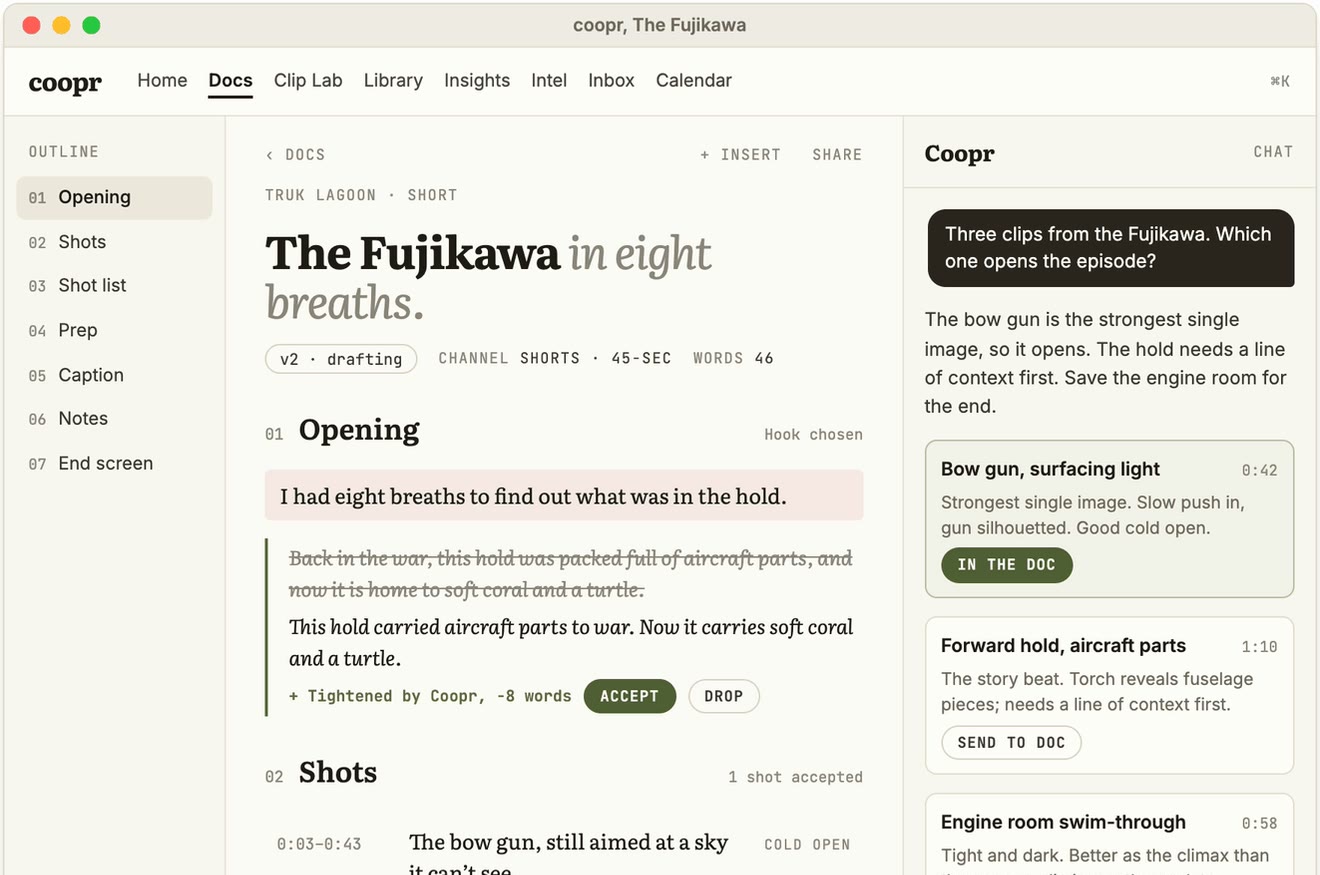
Send a clip to the doc, pick a hook, and accept or drop the rewrite Coopr suggests. Then switch formats: the same accepted material becomes an episode script, carousel slides or a short.
Those variants are plans to shoot from, not rendered videos.
Instead of a model writing straight into the draft
Every answer is something you can act on
The chat doesn’t answer in paragraphs. Each answer arrives as flagged phrases to swap, slides to send to the doc, a checklist Coopr can finish, or two captions to choose from.
Instead of answers in paragraphs
A topic changes when the drift holds
To cut a long talking clip into chapters, Content Brain looks for the point where what I’m saying actually shifts. It compares each phrase with the one before, and a CUSUM adds up how far those comparisons drift above normal: S = max(0, S + d − μ₀ − k), with a break when S passes the threshold.
One odd phrase doesn’t trip it; a sustained change does. COOPR also has a separate PELT detector for regime changes.
Instead of a break at the first odd phrase
How it’s built and checked
- Workflows
- Compare clips, write, check the voice and repurpose each exist in source, but not every handoff between them is proven. I haven’t verified that a ranked clip opens straight into Clip Lab.
- Retention model
- A gradient-boosted regression with pseudo-label and scarce-label handling. It’s real ML code, and I’m not claiming any accuracy for it.
- Evidence
- Retrieval falls back to other sources when the first one comes back thin.
- Interface
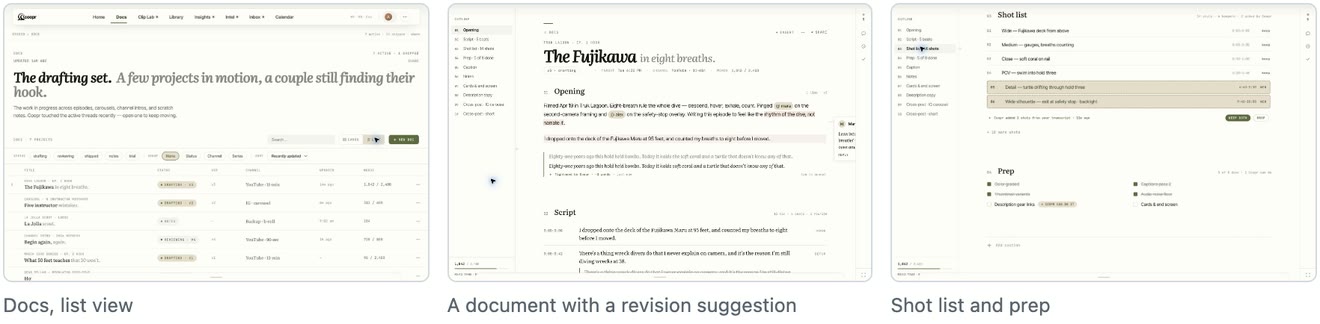
- A prototype in its own design language, with eight workspaces: Home, Docs, Clip Lab, Library, Insights, Intel, Inbox and Calendar.
Where it stands
Exists in source
- Content Brain: audio and motion diagnostics, CUSUM and PELT change detection, and evidence retrieval with fallbacks.
Left unfinished
- I moved on to Reef before the interface was wired to the live backend.
Carried into Reef
- Reef reads Content Brain through a read-only, tenant-bound client that trusts nothing it returns raw.